Four quizzes, four ways to answer
- 4games
- 20languages
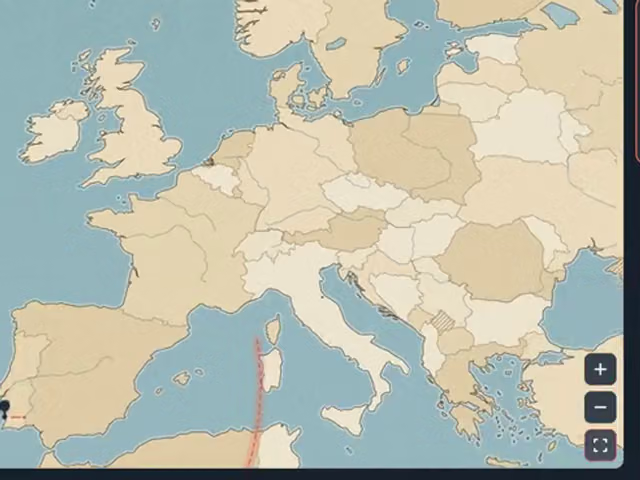 Azimuth Geography,
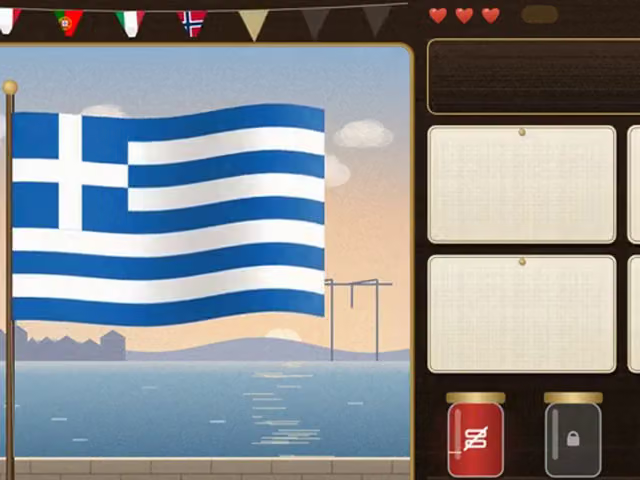 Tincture Flag Quiz,
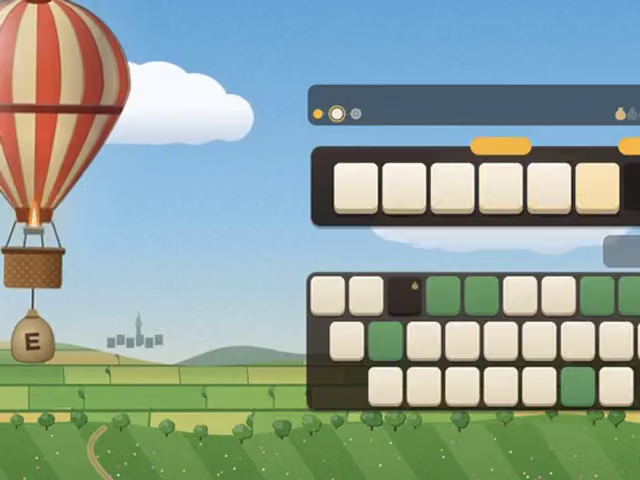 Ballast Hangman and
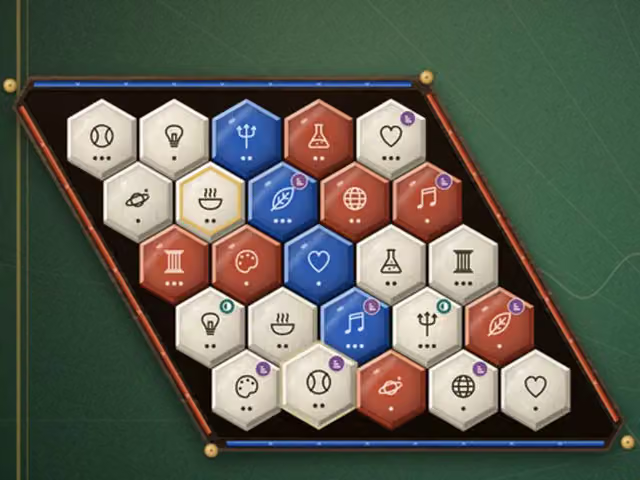 Faience Trivia are the quiz games here, and none of them is a plain list of questions. Azimuth has you tap places on a world map, Tincture flies a flag with four answers under it and a clock running, Ballast is a hangman with a category clue in which the stake is a hot air balloon, and Faience is a trivia game played on a hex board. All four are free to play in the browser on a phone, a tablet or a computer, with no account. Each has a daily challenge that is the same for every player that day and a way to play a friend over a room link.
A map quiz with compass clues
Azimuth Geography is the map quiz: clue cards name a place, and you tap the world map where you think it is. A country comes by its name, its capital, its flag, its outline or the countries that border it, and later chapters ask for rivers, landmarks and cities. Hit the place and the card is found, and the next clue takes its slot. Miss, and you still learn something: every open card shows how far its place is from your tap and toward which of eight compass points, and the selected card draws an arc on the map along which its place must lie. Two taps cross two arcs, and the place is where they meet.
Up to four cards are open at once and one tap is judged against all of them, so the tap that finds the country you know is free information for the ones you do not. A tap that lands on two places at once, such as a country and its capital, finds both for 150 extra points.
Pins and sharp finds
Every tap costs a pin, and a stage ends when the pins run out with places still open. A place found before any reading of it is a sharp find: it gives its pin back, and sharp finds in a row raise your points up to double. Each stage can earn three stars: clear it, clear it within a par number of taps and make three sharp finds. Disputed areas are hatched on the map and belong to no country: they are never asked for, and a tap inside one does not count.
Nine chapters, 54 stages
Europe opens with one card and grows to three. The Americas add capitals, Africa flags, Asia neighbours and the Ocean Rim outlines of island and Pacific countries, on a map turned to face the Pacific. Great Rivers asks you to tap anywhere along a river that stays hidden until found, Wonders names a landmark from a one-line description, and Cities at Night finds 74 cities on a dark map. The Grand Tour mixes every kind of clue with four cards open. Each chapter has six stages of 6 to 12 places, and 20 missions track the rest. Hard mode, opened after Europe or a daily voyage, draws no arcs and starts every stage two pins down.
Daily voyage, endless voyage and a race
The daily voyage is ten places for everyone, and a started voyage resumes after a reload. Voyage is endless: every find adds a pin, a sharp find adds two, and the places get harder with each find. Race a friend gives you both the same 8 or 14 places, three or five minutes, each on your own map in real time. The first to find every place wins, and at the clock more places found wins; the rival's taps and readings never show on your map. Distances come in kilometres or miles, your choice on the title screen.
Tincture: flags, capitals and ink jars
Tincture Flag Quiz covers 203 flags: the 193 UN member states, Vatican City, Palestine and eight territories with flags of their own, such as Greenland, the Faroe Islands and Puerto Rico. A flag flies on the pole and four answers wait below it; tap the right one before the clock runs out. Capitals are asked for most countries, and for a country with several, such as Bolivia, South Africa, Sri Lanka or Eswatini, the answer lists them all. Country and capital names appear in the language of the page.
Every right answer pours the flag's colours into four ink jars, and the ink buys powers: red crosses out two wrong answers, blue stops the clock, green wins back a heart and gold triples the next answer. You have three hearts per stage, and a wrong answer or a timeout costs one. The flags you know pay for the ones you do not, and each region fills different jars: Africa fills green and gold, Europe and the Gulf fill red.
Eight chapters and a flag book
The campaign goes through Europe, the Americas, Africa, Asia, Islands, Night Watch, Market Square and a Grand Tour, 48 stages in all. Each chapter has its own scene and brings a new kind of question: name the flag, find a country's flag among four, pick the capital, spot the real flag among three altered copies, find the flag that belongs to a capital, name a flag while it unfurls, and match four flags to four names. Every flag you name goes into your flag book. The daily quiz is 15 questions for everyone, the marathon runs until your hearts are gone, and hard mode gives you two hearts and 30% less time. Race a friend gives you both the same 12 questions about flags, capitals or both, and the most right answers within two minutes wins.
Ballast: a hangman with a balloon
Ballast Hangman shows a hidden word as blank tiles, with a category clue and an alphabet to call letters from. There is no gallows: every wrong letter hangs from the basket of a hot air balloon as a sandbag, and the sixth bag sets it down in the field. The twist is cutting loose. Whenever the letters on your bags spell a real word of three letters or more, you can spell it and cut those bags loose: the balloon climbs back and the word scores by its length. A missed vowel makes a useful bag, and the bags stay on board from word to word through a flight of three to five words. The game tells you when your bags hold a word and how long it is, never which one.
Six chapters, 48 flights
Meadow Fair teaches the basics, and each place after it adds a rule: wind marks on the Chalk Coast, where revealing one sheds your newest bag, a cipher of glyphs in the Red Canyon, two words at once at Lake Woods, phrases of up to five words on the Glacier Peaks, and every rule together under the Northern Night. Long haul keeps the words coming until you touch down, and hard mode sets you down at five bags, asks four letters for a cut and gives no hint about your bags. The daily flight is five words for everyone, one of each kind. Play with a friend shares one word in turns: a hit keeps your turn, a miss hangs a bag on your own balloon, and cutting loose is a free move, in matches of three or five words.
Ballast has its own word lists in English, Turkish, Spanish, French, Portuguese, Russian, Arabic, Indonesian, German, Italian, Polish, Dutch and Ukrainian. Open it on a page in one of those languages and it plays that language's words; on a page in any other language it plays English words.
Faience Trivia: every question is a tile
Faience Trivia is played on a rhombus of hexagonal tiles. Each open tile shows a category and one to three dots for its difficulty, so you choose what you are asked: route your chain through the planets if space is your strength, or take the tile that blocks your rival. You glaze tiles blue and your rival glazes them terracotta; you join the top edge to the bottom edge while the rival joins left to right. A hex board cannot end in a draw. You take turns picking a tile, but both of you answer its question against one clock: the first right answer glazes the tile, a wrong answer locks you out of that question so the other side can still take it, and a fast answer on your rival's pick steals the tile it wanted. A right answer pays 100 points per dot plus a speed bonus.
There are more than 1,200 questions in twelve categories, from science and history to music, food and myths, in choice, true or false and order kinds. The campaign runs through eight chapters of five boards, 40 in all: the Studio, Courtyard, Bathhouse, Map Room, Station Hall, Night Market, Palace Garden and Grand Hall. Each chapter brings a new rule: true or false tiles, keystones that glaze a second tile, questions where you tap four items into order, a contest that lets you challenge a rival tile, fog that hides the inner tiles until a neighbour is glazed, wild tiles where you name the category, and a 6 by 6 board in the Grand Hall.
The daily board is the same board for everyone each day and is scored against that day's other players. Hard mode opens after the Studio or a daily board: the rival knows more and answers faster, your clock is a quarter shorter and the rival picks first. Play with a friend is a real-time race on one board. Twelve category plates glaze as you reach 25, 75 and 150 right answers in each.
Frequently asked questions
How is the distance measured?
Along the Earth's surface, from your tap to the nearest point of the place: a country's border, the course of a river or the spot of a city or landmark.
Why did a tap next to a small country not count?
A tap counts inside the country or very close to its border, and small countries get a little more room. Zoom in with a pinch, the scroll wheel or the plus button before tapping small places.
How are borders drawn?
Borders follow a neutral world map. Disputed areas are hatched and belong to no country: they are never asked for, and a tap inside one does not count.
How many flags does Tincture Flag Quiz have?
203: the 193 UN member states, Vatican City, Palestine and eight territories with flags of their own. Territories and Palestine are never asked for a capital.
Which languages does Ballast Hangman play?
Its own word lists cover English, Turkish, Spanish, French, Portuguese, Russian, Arabic, Indonesian, German, Italian, Polish, Dutch and Ukrainian; on a page in any other language the words are English.
How many questions does Faience Trivia have?
More than 1,200, in twelve categories from science to myths. Every tile shows its category and its difficulty in dots before you pick it, so you choose what you are asked.